
All Hail Saint Nick: Reviews of One Battle After Another and More...
"We are forgetting how to give presents." -Theodor Adorno

Some capsule reviews and takes to warm your gams by the fire with...
FILMS
One Battle After Another, Paul Thomas Anderson
A very fun film that holds up worse under interrogation than its ostensible revolutionaries. The internal logic of the narrative suggests a surveillance state and crushing white-supremacist authoritarianism that is fast able to swallow up nearly the entire leadership of the French 75 and the miscegenating Colonel Lockjaw but mysteriously leaves Willa and Bob Ferguson untouched in the end even though they have a remarkable story to tell that would embarrass the Christmas Adventurers. Nearly all of the other characters are forced to betray their principles except the bumbling Leo DiCaprio, who is rescued time and again by people more competent than he. One could practically see PTA’s gigantic hand protecting Leo on the IMAX screen.
I suspect Paul Thomas Anderson did not want to end the movie in the way its own narrative logic suggested he would have to: as bleakly as Chinatown or his own There Will Be Blood. If he had, it would have been his stand-in and the stand-in for his own daughter who had to suffer. And we wouldn’t have been able to walk out of the theater feeling hopeful and dancing to “American Girl” (as some at my showing were). I also suspect PTA wanted to make a film that gave his viewers hope in a dark time. If so, he might have made that hope at least coherent.
Patriotism, Yukio Mishima / The Woman Who Wanted to Die, Kôji Wakamatsu
Watched as a part of a special screening of one of the only two remaining prints at Japan Society. Aroused such revulsion in me I almost threw up in the theater. The film blithely eroticizes fascism and honor, using a love for Imperial Japan as a narcissistic pretext for a grandiose suicide.
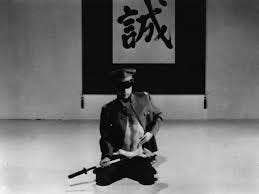
Mishima stars as himself, and although the suicide is supposed to be about and in the name of the death of his nation’s honor, what actually appears on film for the most part is Mishima’s own body, and an enormous amount of blood and guts. It wasn’t the blood that caused me to feel sick but the realization that fascism and patriotism are in the end nothing more than a tremendous narcissistic desire to glorify one’s own self—to create some symbol worth sacrificing one’s own inflated sense of self for.
The Woman Who Wanted to Die, which followed the screening directly, recognizes this narcissism as fundamental to Mishima’s aesthetics and project. Taking place (and filmed) directly in the aftermath of Mishima’s suicide, it follows two sets of lovers who are inspired by Mishima to commit ritual suicide, but want to forgo the ritual and don’t want to be seen as copycats (even if that’s maybe what Mishima hoped for). Without any real attachment to Imperial Japan, or really any values whatsoever except a desire to elevate themselves beyond loserdom through a romantic death, they drift from room to room, begging each other to commit suicide with the other. I think if I had not seen Patriotism beforehand this would’ve struck me as a breathtakingly nihilistic movie…but with Patriotism as an appetizer, it was realized as a tremendous satire of a society secretly obsessed with its own fantasies of supremacy.
Resurrection, Bi Gan
In this film’s world, dreams are what keep us from eternal life: they cause us to age and eventually die.
Who would want to dream then but someone who wanted to die, who had lived a life of crushed hopes and shame? And what would their dreams be but nightmares, deathwishes, fantasies of their own comeuppance?
Can’t recommend this enough. The colors, the cinematography: each shot is lovingly textured and considered. The ending felt like a tremendous stretch but it sent the famous chill down my spine.
The Secret Agent, Kleber Mendonça Filho
A political thriller, in a sense, much like OBAA, but it is framed almost like Don DeLillo’s Libra. That is, we see Wagner Moura’s story through the computer screen of a student transcribing and migrating old news stories onto the web, rather than experiencing it exclusively contemporaneously. Unlike OBAA, which is a movie about a contemporary subject that hopes to give its audience hope (and accidentally etherizes them in the process), The Secret Agent argues that the legacy of authoritarian states is to destroy legacy: entire family histories are destroyed over vendettas, fathers don’t remember their mothers, and go unremembered in turn by their own children.
The horror, too, is eventually forgotten, but this is not mercy: it is what allows the horror to be perpetuated again.
Blue Moon, Richard Linklater
A film about a sentimental pervert cum alcoholic who hates sentimentality. His incessant self-regard is what keeps him from seeing the truth about his life: he is, in fact, loved, but it is his insistence on pretending that no one else can see his shame that keeps him from feeling that love.
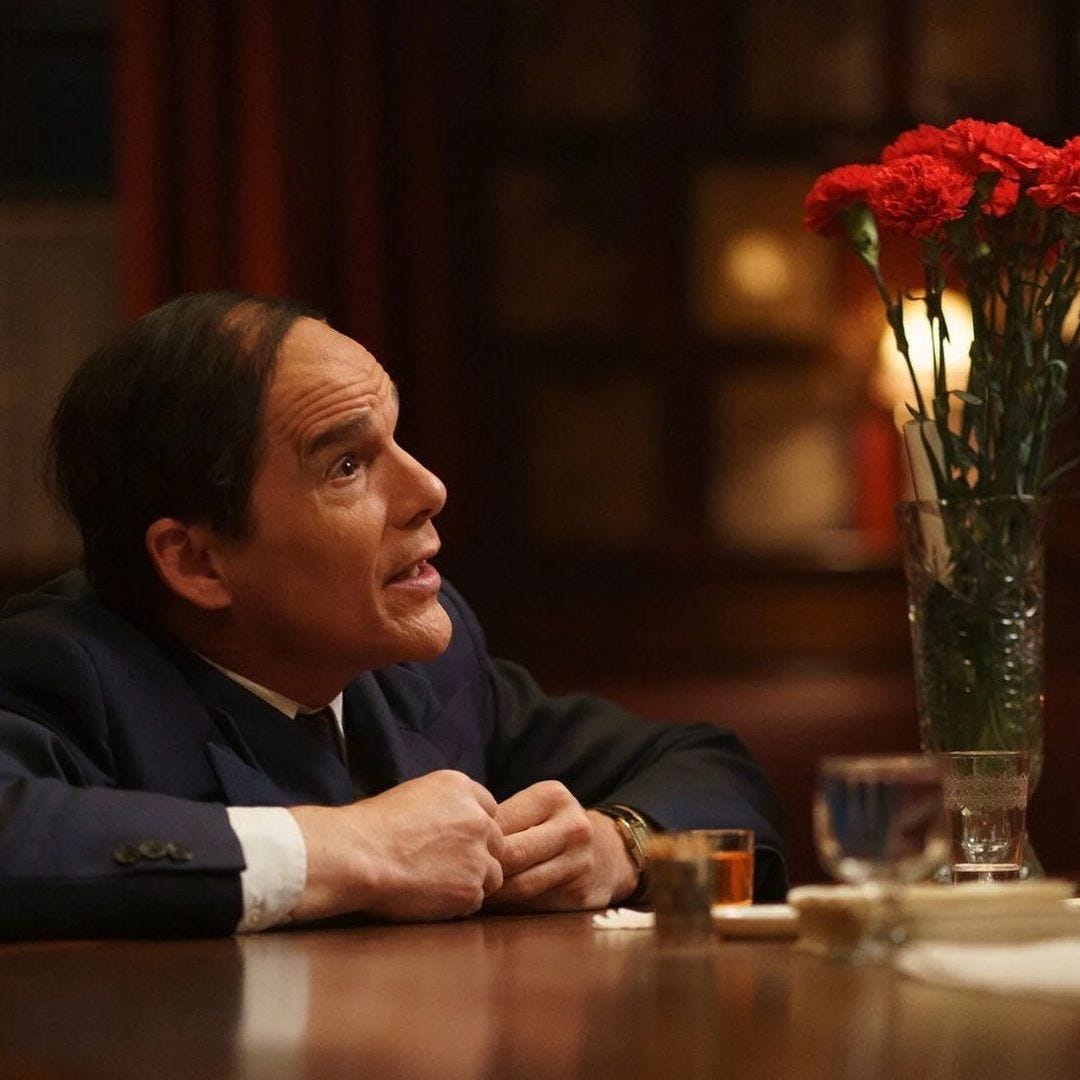
Alternate title: Honey I Shrunk Ethan Hawke.
Bugonia, Yorgos Lanthimos
Yorgos really is the greatest auteur troll of his generation. This film is predicated on what I might call unmotivated withholding: there is no reason for the narrative to keep the truth about Emma Stone’s alienhood from us except to increase the narrative tension. In doing so, it also becomes nonsensical: the first half of the movie portrays Jesse Plemons and his cousin as lunatics, when in fact they are not, they are tragic heroes trying to save humanity. A silly film, but fun. Stavros makes his debut as a pedophile cop.
Oldboy, Park Chan-wook
A rewatch in anticipation of No Other Choice. A silly film at times, despite its gruesome violence.
As always Wook is at his best when he imagines the casual sociopathy and cruelty of the rich, who find themselves subjects to boredom when all their desires are satisfied and all that is left to them is to revenge themselves upon past wrongs. Stop me if that sounds familiar.
Safe, Todd Haynes
Was lucky enough to catch this at IFC Center. Introduced by Haynes and Moore themselves. Capitalism unwittingly chews up even its bourgeoise as it makes even the lives of the rich drab, meaningless. Facing an empty life, Moore’s character’s only comfort, milk, becomes poison to her.
BOOKS
Not a ton of books I’ve read recently, but that’s because I’m trying to work my way through behemoths. (Including Capital.)
Gravity’s Rainbow, Thomas Pynchon
“You want cause and effect? All right.”
What to even say here. Is it the erections causing the rocket attacks, or are the rocket attacks and the erections a part of the same swirling field of atoms? Damned if I know. A lot of good limericks in there, though.
N’gustro Affair/Nada/Three to KIll, Jean-Patrick Manchette
Three bleak little crime novels. The first is remarkable in that it is structured as a tape recording made by a patsy to a political murder (a fictionalization of the actual murder of Mehdi Ben Barka, which prefigured the Khashoggi killing); the second depicts an anarchist groups doomed kidnapping of an American ambassador to France. The third follows a man who accidentally makes himself the subject of a manhunt. Manchette has a serious sense of human beings as products of society: “Once, in a dubious context, he lived through an exciting and bloody adventure, after which, all he could think of to do was to return to the fold. And now, in the fold, he waits…Georges is of his time. And of his space.”
Minima Moralia, Theodor Adorno
A life-changing text. Impossible to summarize or even digest in one read. Its continuing relevance in our own age or rising fascisms cannot be overstated. Here are a series of quotes. They may depress you or enlighten you. That’s up to you.
On wrong life:
“Wrong life cannot be lived rightly.”
On ‘let people enjoy things’ culture:
“The admonitions to be happy, voiced in concert by the scientifically epicurean sanatorium-director and the highly strung propaganda chiefs of the entertainment industry, have about them the fury of the father berating his children for not rushing joyously downstairs when he comes home irritable from his own office.”
“There is a straight line of development between the gospel of happiness and the construction of camps of exterminations so far off in Poland that each of our own countrymen can convince himself that he cannot hear the screams of pain.”
“Cultivated philistines are in the habit of requiring that a work of art ‘give’ them something. They no longer take umbrage at works that are radical, but fall back on the shamelessly modest assertion that they do not understand.”
On revanchist immigrant politics:
“In losing their innocence, the bourgeois have become impenitently malign. The caring hand that even now tends the little garden as if it had not long since become a ‘lot,’ but fearfully wards off the unknown intruder, is already that which denies the political refugee asylum.”
On the boredom and pleasure-seeking of the ultra-rich:
“If people at the top are really bored, it is not because they suffer from too much happiness, but because they are marked by the general misery; by the commodity character that consigns amusements to idiocy, by the brutality of the command which echoes terribly in the rulers’ gaiety, finally by their fear of their own superfluity.”
On a culture absent of tenderness:
“There is tenderness only in the coarsest demand: that no one shall go hungry any more.”
“Life has become the ideology of its own absence.”
On how the frog was boiled in Israel and Gaza, by way of Nazi Germany:
“Only the absolute lie now has any freedom to speak the truth.”
“When the National Socialists began to torture, they not only terrorized the peoples inside and outside Germany, but were the more secure from exposure the more wildly the horror increased. The implausibility of their actions made it easy to disbelieve what nobody, for the sake of precious peace, wanted to believe, while at the same time capitulating to it.”
“Every horror necessarily becomes, in the enlightened world, a horrific fairy-tale. For the untruth of truth has a core which finds an avid response in the unconscious.”
“So desperate have people become in civilization, however, that they are forever ready to abandon their frail better qualities as soon as the world does their worse ones the obligation of confessing how evil it is.”
“The sadism latent in everyone unerringly divines the weakness latent in everyone.”
“The outbreak of the Third Reich did, it is true, surprise my political judgement, but not my unconscious fear.”
On slippers:
“Slippers are designed to be slipped into without any help from the hand. They are monuments to the hatred of bending down.”
On faeces:
“The brightest rooms are the secret domains of faeces.”
“The almost insoluble task is to let neither the power of others, nor our own powerlessness, stupefy us.”
On capitalism and state power and how we could live in a world where a president can just say out loud that he intends to invade Venezuela for oil:
“State power has shed even the appearance of independence from particular interests in profit; always in their service really, it now places itself there ideologically.”
“Difficult to write satire. Not only because our situation, which needs it more than any ever did, makes a mockery of mockery.”
“Among today’s adept practitioners, the lie has long lost its honest function of misrepresenting reality. Nobody believes anybody, everyone is in the know.”
“Fascism was the absolute sensation: in a statement at the time of the first pogroms, Goebbels boasted that at least the National Socialists were not boring. In the Third Reich the abstract horror of news and rumour was enjoyed as the only stimulus sufficient to incite a momentary glow in the weakened sensorium of the masses.”
“The immorality of lying does not consist in the offense against sacrosanct truth. An appeal to truth is scarcely a prerogative of a society which dragoons its members to own up the better to hunt them down.”
“The fixed, inspecting, hypnotic and hypnotized stare that is common to all the leaders of horror, has its model in the appraising look of the manager asking an interview candidate to sit down.”
“It is the signature of our age that no-one, without exception, can now determine his own life within even a moderately comprehensible framework, as was possible earlier in the assessment of market relationships. In principle everyone, however powerful, is an object.”
“The constantly enforced insistence that everybody should admit that everything will turn out well, places those who do not under suspicion of being defeatists and deserters.”
“The optimism of the left repeats the insidious bourgeois superstition that one should not talk of the devil but look on the bright side.”
On the inevitability of doom:
“Zoological gardens...are laid out on the patter on Noah’s Ark, for since their inception the bourgeois class has been waiting for the flood.”
“So, when we are hoping for rescue, a voice tells us that hope is in vain, yet it is powerless hope alone that allows us to draw a single breath.”
“He who dies in despair has lived his whole life in vain.”
“What is constant is not an invariable quantity of suffering, but its progress towards hell.”
On insight:
“The splinter in your eye is the best magnifying glass.”
“True thoughts are those alone which do not understand themselves.”
On happiness:
“To happiness the same applies as to truth: one does not have it, but is in it.”
“Work while you work, play while you play--this is a basic rule of repressive self-discipline.”
“No emancipation without that of society.”
“The only philosophy which can be responsibly practiced in face of despair is the attempt to contemplate all things as they would present themselves from the standpoint of redemption.”
On pornography:
“How intimately sex and language are intertwined can be seen by reading pornography in a foreign language.”
On Christmas:
“We are forgetting how to give presents.”
On Sunday:
“Sunday fails to satisfy, not because it is a day off work, but because its own promise is felt directly as unfulfilled.”
CHRISTMAS CONTENT
Blast of Silence.
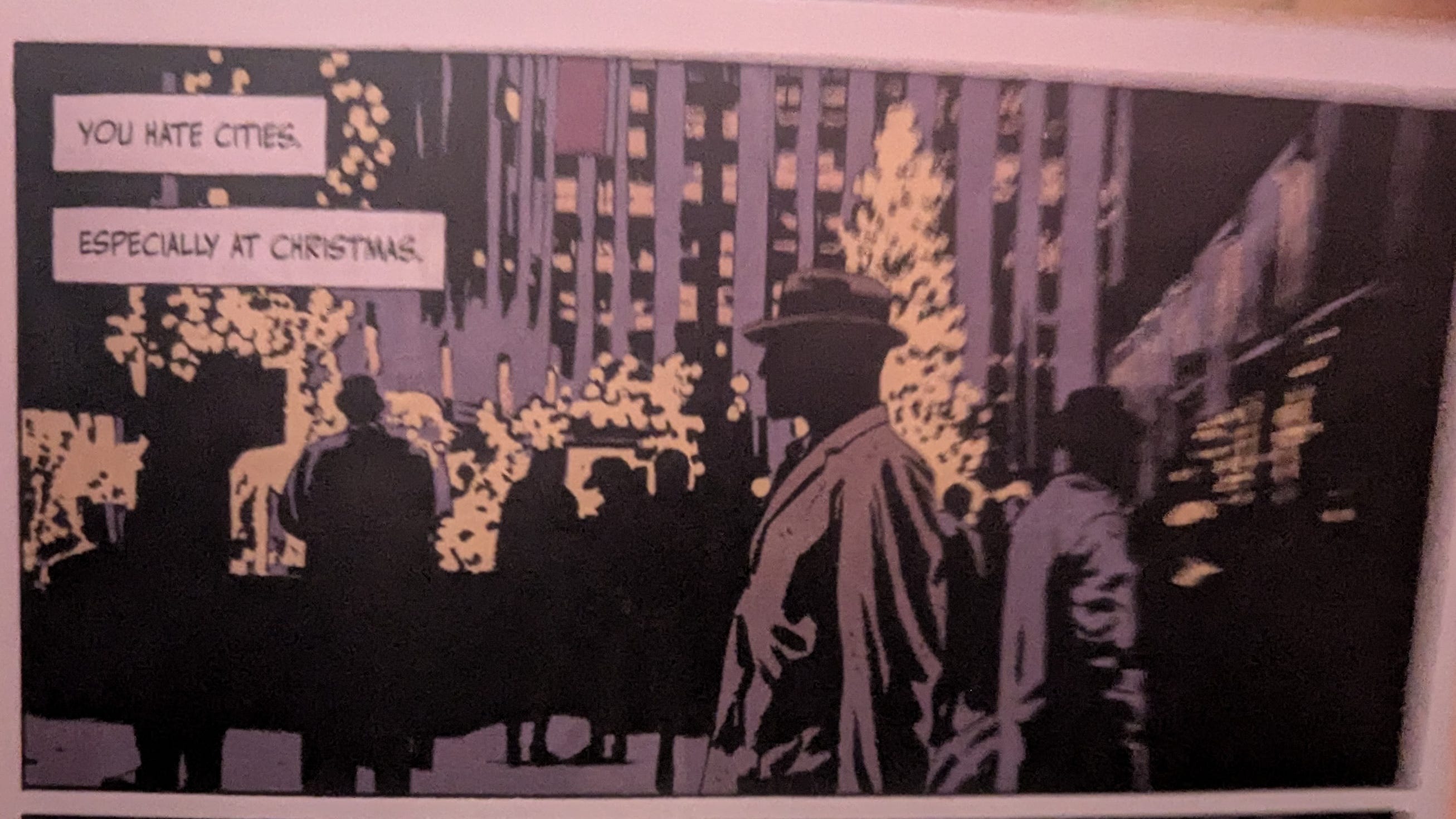

See it if you know what’s good for you. Some thoughts I wrote down a year or two ago.
Until next time…